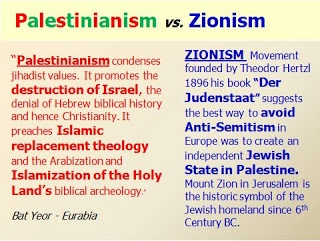
Palestinianism: in depth
I
Ironically, Palestinianism is inspired by Zionism. Palestinianism is a crude pastiche of the 2,000-year-old Jewish desire to re-establish a homeland in the Middle East. The Palestinian Arabs did not seek to establish a homeland until after the formation of the State of Israel in 1948, and even then they were more concerned with destroying the Jewish state than actually focusing on how to build their own democratic institutions. Once it was clear that the Arab states could not defeat Israel in the wars of 1947-8 and 1967, the Arabs had no choice but to invent a Palestinian nationalism, which involved the appropriation of Israeli land, especially Jerusalem and the Jewish heartland of Judea and Samaria. The invention of Palestinianism – which is symbolized by the invention of the Nakba and the ambition to divide Jerusalem – is a political tool designed to undermine Israel’s existence and security.
Before the creation of Israel, the word “Palestinian” usually denoted the Jewish occupants of the Land of Israel. (That is why The Jerusalem Post used to be called The Palestine Post.) In a 1939 essay, George Orwell referred to the “Arabs” on the one hand and “Palestine Jews” on the other. All of which helps explain why Arab leaders like Auni Bey Abdul-Hadi told the Peel Commission in 1937: "There is no such country as Palestine. Palestine is a term the Zionists invented.”
In a sense, he was right. Never in history has there been a country called Palestine. As Arab historian Philip Hitti told the Anglo-American Committee of Inquiry in 1946, "there is no such thing as Palestine in history.” In the years and decades preceding the establishment of the State of Israel, Arab riots and pogroms against British rule were not directed towards the creation of a Palestinian state. And the Arab massacres of Jews in the 1920s and 1930s were inspired by anti-Semitism, not by a desire for an independent Palestinian state.
In 1947, Arab leaders protesting the UN partition plan argued that Palestine was part of Syria. Indeed, before the 1960s, many Arab yearned for a “Greater Syria.” There was no Palestinian nation at the time of Israel’s independence and there was no demand for Palestinian statehood when Egypt controlled Gaza and Jordan occupied Judea and Samaria (“the West Bank”) from 1948 to 1967.
The words “Palestinian” and “Palestine” were only appropriated by a number of Arabs when it became clear that the Jewish state was a fact. Since the 1960s, the word “Palestinian” has been invested with a political significance designed to undermine Israel’s legitimacy.
Yasser Arafat, the icon of the Palestinianist movement, admitted that “the Palestinian people have no national identity.” And he went on to boast that he, as a “man of destiny,” will provide that identity “through conflict with Israel.” And in an interview with a Dutch newspaper in 1977, PLO executive committee member Zahir Muhsein stated: "The Palestinian people does not exist. The creation of a Palestinian state is only a means for continuing our struggle against the state of Israel for our Arab unity.”
One of the enduring myths of the Arab-Israeli crisis is that the Palestinians are an indigenous people. Palestinians are not an ethnic sub-group. There is no such thing as an ethnic Palestinian. Arabs in Israel and the West Bank are ethnically identical to Arabs living in Jordan, Iraq, Syria, Egypt. The population in Gaza is largely Bedouin Arab in origin.
Furthermore, many of the Palestinian Arabs living in Israel in 1948 were themselves immigrants who came to the land in the wake of successful Zionist enterprises. The Zionists offered a better standard of living and higher wages than neighboring Arab employers. Before the earliest Zionist settlers arrived at the end of the 19th century, the land was sparsely populated and desolate.
Palestinianism, then, is a recent invention. It was born out of the Arab defeat of the Six-Day War in 1967. The realization that the Jews would not be “driven into the sea” meant that the Arabs had to find another way of liquidating the Jewish inhabitants of the Holy Land. The sudden desire for a Palestinian state was – and still is – a tool to delegitimize and destabilize the State of Israel. But deploying the twin engines of terror and politics were not enough. For how can a state be built on a lie? There is neither an authentic Palestinian culture or history to build on. This may explain why Palestinians are unable to establish functioning institutions, despite the countless opportunities to establish their own state. Instead, the Palestinians had to invent an ideology – Palestinianism – which could be exported around the world, garnering the support of Far Left groups and radical Islamists.
II
According to French philosopher Jean Baudrillard, contemporary society is alienated from “the real” due to an “ecstasy” of information. Media consumers, he points out, live in a “hyper-real” universe where reality is simulated. Indeed, many people (in the West and in the Muslim world) are alienated from the reality of the Arab-Israeli conflict due to an overload of disinformation, pseudo-historical posturing and faked news footage emanating from the Palestinianists. Truth and historical facts are relegated and replaced by a fabricated “reality” that is mediated by television, newspapers, films and the internet.
The derealization of the Arab-Israeli conflict is fought by Palestinianists with the weapons of delegitimization, defamation, disinformation, anti-Semitic propaganda, pseudo-history, faked news footage and boycotts. This Kulturkampf (“culture war”) is advanced in several arenas, notably the media, on campuses, among trade unions and especially the internet. Indeed, Israel’s critics and enemies are very adept at using the internet as a tool for spreading propaganda and conspiracy theories. The internet is a kind of electronic intifada in which falsehoods are routinely – and easily – produced.
The fact that Palestinianism has found such a willing audience around the world strongly suggests the idea of the “real” or objective reality has been well and truly shattered. As far as the global media is concerned, faked events and pseudo-facts are no less real than reality itself. Indeed, they may be more real because they serve a “higher cause”, which is the demonization of Israel. The best example of the “death of the real” is the phenomenon known as Pallywood.
Pallywood, a portmanteau of Palestinian and Hollywood, is a coinage used by some media watchdogs to describe doctored and fake media footage produced by the Palestinians to illustrate their false but lethal narratives about Israel. Calev Ben-David, writing in The Jerusalem Post, describes Pallywood as "media manipulation, distortion and outright fraud by the Palestinians and (and other Arabs, such as the Reuters photographer caught faking photos during the Second Lebanon War), designed to win the public relations war against Israel.”
Canadian columnist Paul Schneidereit writes: “We've seen cases where the bodies of Palestinian martyrs carried on stretchers are inadvertently dropped, then, of their own volition, climb back on again. We’ve seen reports of massacres, as in Jenin in 2002, that turned out, after independent investigation, to have been greatly exaggerated. Needless to say, such episodes don’t instill an abiding trust in subsequent Palestinian claims, at least until they’re verified."
The methods used by the Palestinian disinformation industry include:
1. Using visual media to construct fake stories of Israeli atrocities. This involves editing media footage and staging events. For example, directing Palestinian civilians, ambulance drivers, doctors and police to “act out” roles such as the “injured man”, the “dead child”, the “concerned medic”, the “brave freedom fighter.” Palestinian journalists and cameraman are complicit in this theatre of propaganda.
2. Luring Israeli soldiers into schools, shelters and hospitals and using civilians as human shields in order to increase the casualty rate. For example, in 2009 Hamas militants fired mortar shells from a school in Gaza. The IDF returned fire, resulting in 40 civilian fatalities.
3. Ignoring or downplaying attacks on Israeli civilians, and omitting to mention the oppression and murder of fellow Palestinians by Hamas and Fatah.
4. Repeating the claim that Israel ethnically cleansed Palestine in 1947-48, despite the fact that Palestinian leaders deliberately spread false rumors of rape and massacres in order to provoke Arab armies to fight on their behalf.
5. Repeating the claim that Israel is a colonialist occupier of a country called Palestine, despite the fact that there has never been a Palestinian nation and that Jews have lived in the Holy Land for the past three thousand years.
6. Claiming that Jerusalem is the capital of a country called Palestine despite the fact that Jerusalem has never been the capital of an Arab or Muslim entity.
7. Depicting the Israelis as Nazis and claiming the Jews faked or exaggerated the Holocaust.
8. Masking the prosperity of the Gaza Strip by focusing on isolated examples of hardship.
9. Disseminating faked reports of massacres, deaths of children, atrocities and privations to the Western media. e.g. claiming the Israelis had carried out a massacre in Jenin in 2002.
10. Appealing to the United Nations, Amnesty International, the Western media and NGOs for help and/or aid, despite the fact that Israel provides aid and/or allows passage for humanitarian assistance.
Untruth, it seems, is the currency of Palestinianism, but sadly it is a currency that buys a lot of media coverage. Israel, perhaps because of its higher ethical standards and commitment to authentic narratives, has not resorted to the tactics of disinformation and faked news footage. But as a result, Israel is facing a severe crisis of representation because traditional modes of understanding – i.e. the relation between fact and reportage – are no longer be considered useful or even valid.